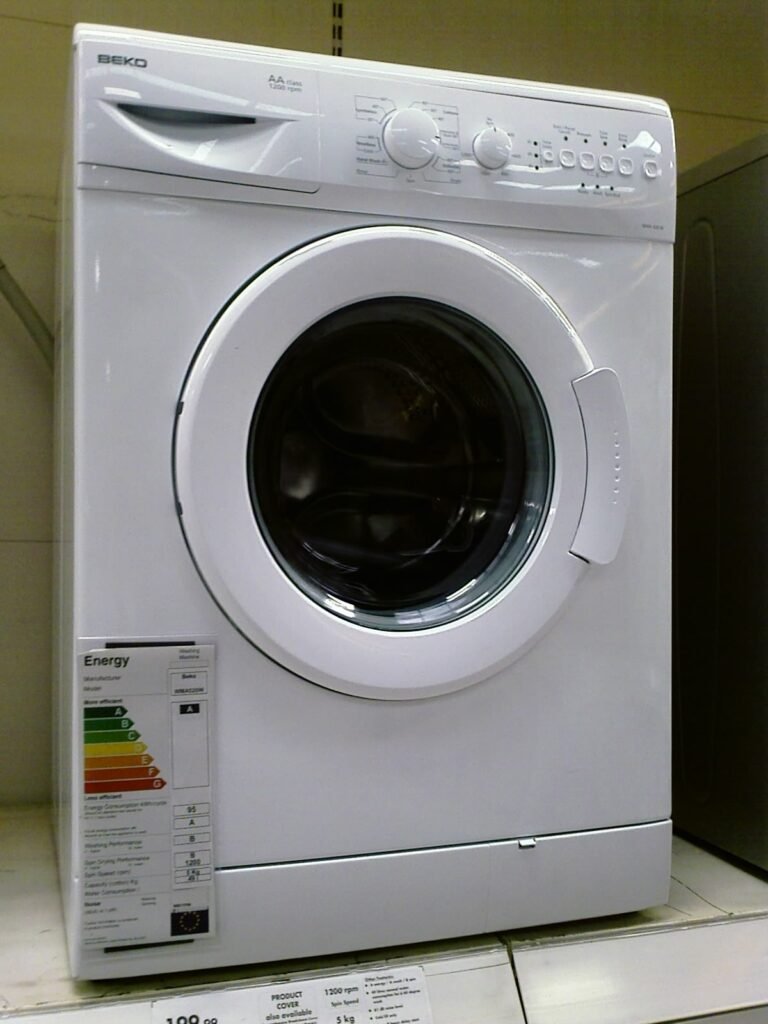
You start the washing machine, step into the shower, and the water turns to a weak trickle. In many homes, a brief dip is simply what happens when one appliance suddenly asks for a lot of water at once. The trick is knowing when that dip is normal.
Safety First
Unplug the washer before pulling it out or disconnecting a hose, and turn both supply taps off before undoing any hose connection. Leave main-stopcock, PRV, or in-wall pipework to a plumber.
Pressure vs. Flow: The Difference That Explains Most Dips
Pressure is the force pushing water through the pipes, measured in PSI or bar. Flow is the volume actually arriving, measured in gallons per minute (GPM). A home can have healthy pressure and still run short of flow: a shower uses around 1.5 to 3 GPM, while a washing machine can draw roughly 3 to 5 GPM on each supply line during its initial fill. Run both together and total demand can approach 10 GPM. If older half-inch pipes cannot deliver that volume at once, the water is shared between open outlets, and every tap feels weaker.
A short, mild dip while the washer fills is usually normal; investigate if the drop is severe, the washer fills very slowly alone, or taps are weak with the washer off.

Cause 1: Too Much Demand at Once on Shared Pipes
When the washer’s fill valve opens, it takes a large share of the water on that branch, so a shower or tap running at the same time leaves less for everything else. Test it free: run the washer alone, then open a shower while it fills. If the washer fills fine alone, you have a demand problem, and staggering laundry and showers is a genuine fix.
Cause 2: A Partly Closed Valve
Washer taps must be fully open — halfway acts as a bottleneck. The same applies to the main house stopcock: a gate-style valve left partly closed restricts flow to the whole property. Turn both washer taps fully anticlockwise and confirm the main stopcock is fully open.
Cause 3: Clogged Inlet Screens on the Washer
Where each supply hose meets the back of the washer sits a small mesh inlet screen, catching grit, rust, and limescale before they reach the valve. To clean them, unplug the machine, turn both taps off, disconnect the hoses, ease each screen out with pliers, rinse and brush away scale, then refit and check for drips. In hard-water areas, do this yearly. For a related supply-side fault, see our guide to water drips in washing machine when off.
Cause 4: Kinked, Squashed, or Ageing Supply Hoses
A hose trapped, bent sharply, or flattened by the machine’s weight restricts flow like a partly closed valve. With the power off, pull the machine out and check both hoses along their full length for kinks, tight bends, or bulges. Straighten kinks and leave slack so the hose is not crushed. Replace any bulging, cracked, or five-plus-year-old hose with a braided stainless-steel one.
Cause 5: A Failing or Misadjusted Pressure-Reducing Valve (PRV)
Many homes have a pressure-reducing valve near the main meter, capping pressure at around 40 to 60 PSI. When a PRV wears out or is set too low, it chokes flow to the whole house, and the washer’s sudden demand exposes the shortfall. Test it with a cheap screw-on pressure gauge on an outside or laundry tap, reading it at rest and again while the washer fills. A large fall, or a reading below about 40 PSI, suggests the PRV needs a plumber’s attention.
Cause 6: Old, Narrow, or Scaled-Up Pipes
Older homes often have half-inch lines and galvanised steel pipes that corrode internally, narrowing the bore until one outlet at a time is all they can serve. If the drop is worst in one part of the house, or has crept up gradually over years, restricted pipework is a strong suspect.
Cause 7: A Leak, a Hidden Restriction, or a Weak Mains Supply
A leak steals water before it reaches your taps. Watch for a water meter that creeps when nothing is running, damp patches, a constantly running toilet, or a whole-house filter or softener not serviced in years — a clogged cartridge restricts flow to the entire house. If neighbours report the same problem at peak times, ask your water supplier whether the mains is under strain.
Diagnose It in Order
- Run the washer alone. If it fills normally, stagger use.
- Check the valves. Washer taps and main stopcock fully open.
- Inspect the hoses. No kinks, squashing, bulges, or cracks.
- Clean the inlet screens. Rinse the mesh filters at the back of the washer.
- Measure the pressure. Gauge reading at rest and during a fill.
- Look for leaks and clogged filters. Meter test, toilet check, filter service.
- Call a plumber if severe, house-wide, or pointing to the PRV, pipes, or a leak.
If the machine itself misbehaves in other ways, our guide to a washing machine not working walks through the checks in order, and if it will not empty either, see why washing machine won’t drain.
Fixes Worth Paying For — and Prevention
Most causes here cost nothing: fully open valves, unkinked hoses, clean inlet screens, and staggered laundry times. Paid fixes, cheapest first: PRV adjustment or replacement, filter service, a booster pump for genuinely low mains pressure, and re-piping. Prevent recurrence: clean screens yearly, replace hoses every three to five years, and service filters on schedule.
Frequently Asked Questions
Why does my shower go weak when the washing machine is running?
Both share one supply, and the washer draws a large volume quickly during its fill cycle, splitting the available flow. A brief dip is normal; a trickle points to a restriction such as a partly closed valve or clogged inlet screens.
Is it normal for water pressure to drop when the washing machine is running?
A short dip while the machine fills is normal in many homes, especially older ones with half-inch pipes or a shared branch line. It is not normal if pressure collapses, the washer fills very slowly alone, or taps are weak with the washer off.
How do I fix low water pressure when my washing machine is running?
Work in order: open the washer taps and main stopcock fully, straighten any kinked hoses, and clean the inlet screens at the back of the machine. If that fails, measure pressure with a gauge and check for leaks or a clogged filter.
Can a washing machine damage my home’s water pressure permanently?
No — the machine does not damage your plumbing’s pressure. It only reveals an existing capacity or restriction problem; fixing that cause restores normal pressure.
When should I call a plumber about a pressure drop?
Call a plumber if pressure is low throughout the house even with nothing running, if you suspect a leak, if the pressure-reducing valve needs adjusting or replacing, or if the pipework is old galvanised steel.
Pingback: Where Does Water from Washing Machine Go?